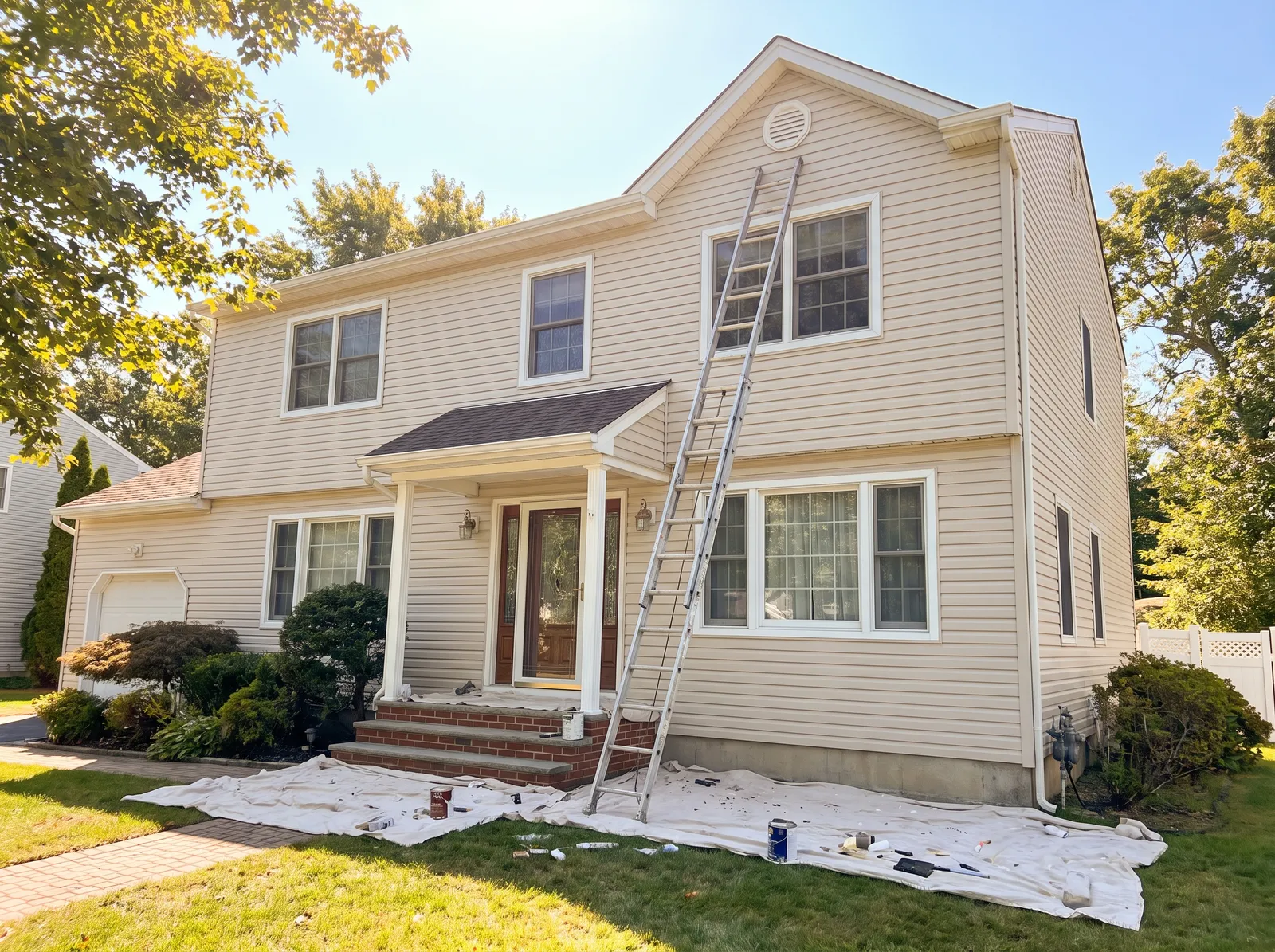
Exterior paint is the first thing anyone sees and the last thing most homeowners think about, until it starts peeling. On Long Island, where salt air, humid summers, and freezing winters all work against your siding, the real question is not just how often to repaint on a calendar, but how to read the signs your house is already showing you. This guide gives you honest timelines by surface, the Suffolk and Nassau factors that speed up wear, and how to tell when it is truly time.
The general timeline, and why it is only a starting point
As a rule of thumb, most exteriors need repainting every five to ten years, but that range is wide for a reason. The material under the paint matters more than any single number. Wood siding and trim, common on older Long Island homes, usually needs fresh paint every five to seven years. Fiber cement and stucco can hold a coat for eight to twelve years. Aluminum siding often goes five to ten years before the finish chalks and fades, and vinyl, while it does not need paint to survive, can be repainted every ten years or so when the color tires or you want a new look.
The trap is treating that number as a promise. A house that faces the afternoon sun on its south and west walls will wear those sides years faster than the shaded north face, so it is normal for one elevation to fail while another still looks fine. The calendar tells you when to start paying attention. The house itself tells you when to act, and on the Island the house usually speaks up sooner than the brochure suggests.
Warning signs it is time, not just a hunch
You do not need a moisture meter to know your paint is failing. The clearest sign is peeling, cracking, or flaking, where the film lifts off the siding and you can see bare wood or a previous color underneath. Close behind it is chalking, a dull, powdery residue that rubs off on your hand when you touch the wall. That powder is the paint breaking down under years of sun and salt, and it means the surface has stopped protecting the material below.
Fading is subtler but still telling. If your south and west walls are noticeably lighter than the shaded sides, the pigment and binders are worn out. Look also for hairline cracks in the caulk around windows and doors, gaps at trim joints, and any soft, dark, or blistered spots that suggest moisture is getting behind the paint. On wood, bubbling almost always means water intrusion, which is a repair issue as much as a paint one.
The rule that saves the most money is simple: repaint before the old coat fails completely. Once bare wood is exposed to Long Island weather, it soaks up moisture, swells, and can rot, turning a straightforward paint job into carpentry and replacement. Catching the wear at the peeling-and-chalking stage keeps the work to paint alone.
What Long Island weather does to your paint
The Island is hard on exteriors in a way inland regions are not, because it hits paint from several directions at once. Summers are hot and humid, winters bring freezing temperatures and ice, and the shoulder seasons swing quickly between them. That constant expansion and contraction as surfaces heat and cool makes paint films crack and lose their grip faster than a steadier climate would.
Then there is the water. On the South Shore, from Long Beach and the barrier islands to the towns along the Great South Bay, salt air is a daily reality. Salt is corrosive and abrasive, it settles on siding, holds moisture against the surface, and wears finishes down years faster than the same paint would fade a few miles north. Homes near the water, exposed to steady wind-driven rain and sea spray, almost always fall at the shorter end of every repaint range. Add the Island's humidity, which feeds mildew and mold on shaded and north-facing walls, and you have a climate that rewards good paint and punishes cheap shortcuts.
None of this means you are fighting a losing battle. It means the products, the prep, and the timing all have to match the environment. A coating and a schedule chosen for a dry inland house will not perform the same on a windy street two blocks from the bay.
Older homes and the prep that makes paint last
Much of Long Island's housing stock dates back decades, from postwar Levittown capes to older colonials across Nassau and Suffolk, and those homes bring their own history to every paint job. Wood siding and trim that has been painted five or six times already, old caulk that has hardened and cracked, and past repairs that were never sanded smooth all have to be dealt with before a new coat goes on. This is exactly why two similar looking houses can need such different amounts of work.
Good exterior paint is roughly eighty percent preparation and twenty percent painting. Scraping loose and peeling paint, sanding rough edges, spot-priming bare wood, replacing failed caulk, and washing off chalk, dirt, and mildew are what let the new coat actually bond and stay put. Skip that work and even premium paint will peel within a couple of seasons of Island weather. Do it right and a quality coat can reach the far end of its expected life. When you get an estimate, the questions about prep and priming tell you more about how long the result will last than the brand of paint on the can.
Cost, timing, and getting a straight answer
Exterior painting is priced by the size and height of the house, the material and condition of the siding, how much scraping, sanding, and repair the surfaces need, and how much trim and detail work is involved. Because those factors vary so much from home to home, typical industry ranges you find online are only a rough guide that shifts with each project. A two-story colonial with tired wood siding near the water is a different job from a single-story ranch with sound aluminum a few miles inland, even at the same square footage. The only honest number is one measured against your actual house.
Timing matters too. On Long Island the best window for exterior painting is late spring through early fall, when temperatures are mild and surfaces stay dry enough for paint to cure properly. Very hot, humid, or cold days work against a good bond, so planning the job for the right season protects the investment. If your exterior is showing peeling, chalking, fading, or cracked caulk, or if it has simply been close to a decade, the smart move is a free on-site estimate. Call Jireh Solutions at (631) 875-9031, and after twenty years working on Island homes we will walk your exterior, tell you honestly whether it is time, and give you real numbers with one clean, reliable crew doing the work.
Frequently asked questions
Yes. Salt air on the South Shore is abrasive and holds moisture against the siding, so finishes wear down years faster than the same paint would a few miles inland. Homes near the bay or ocean usually land at the shorter end of every repaint range and benefit from coatings chosen for coastal exposure.
Small, isolated spots can be touched up, but if peeling or chalking is showing across a whole wall, a full repaint of that surface lasts far longer and looks even. Touch-ups on a coat that is failing everywhere rarely match and tend to peel again within a season or two.
Vinyl does not need paint to protect it, but it can be repainted when the color fades or you want a new look, usually after about ten years. It requires the right products and prep to bond correctly, so it is worth having a professional assess whether painting or another option suits your home.
Late spring through early fall is ideal, when temperatures are mild and surfaces stay dry enough for paint to cure properly. Very hot, humid, or freezing days weaken the bond and lead to early failure. Booking the job for the right season is one of the simplest ways to make a coat last its full expected life.